What We Learned From Josh's Bets: Week 1
Sunday Bet Recap
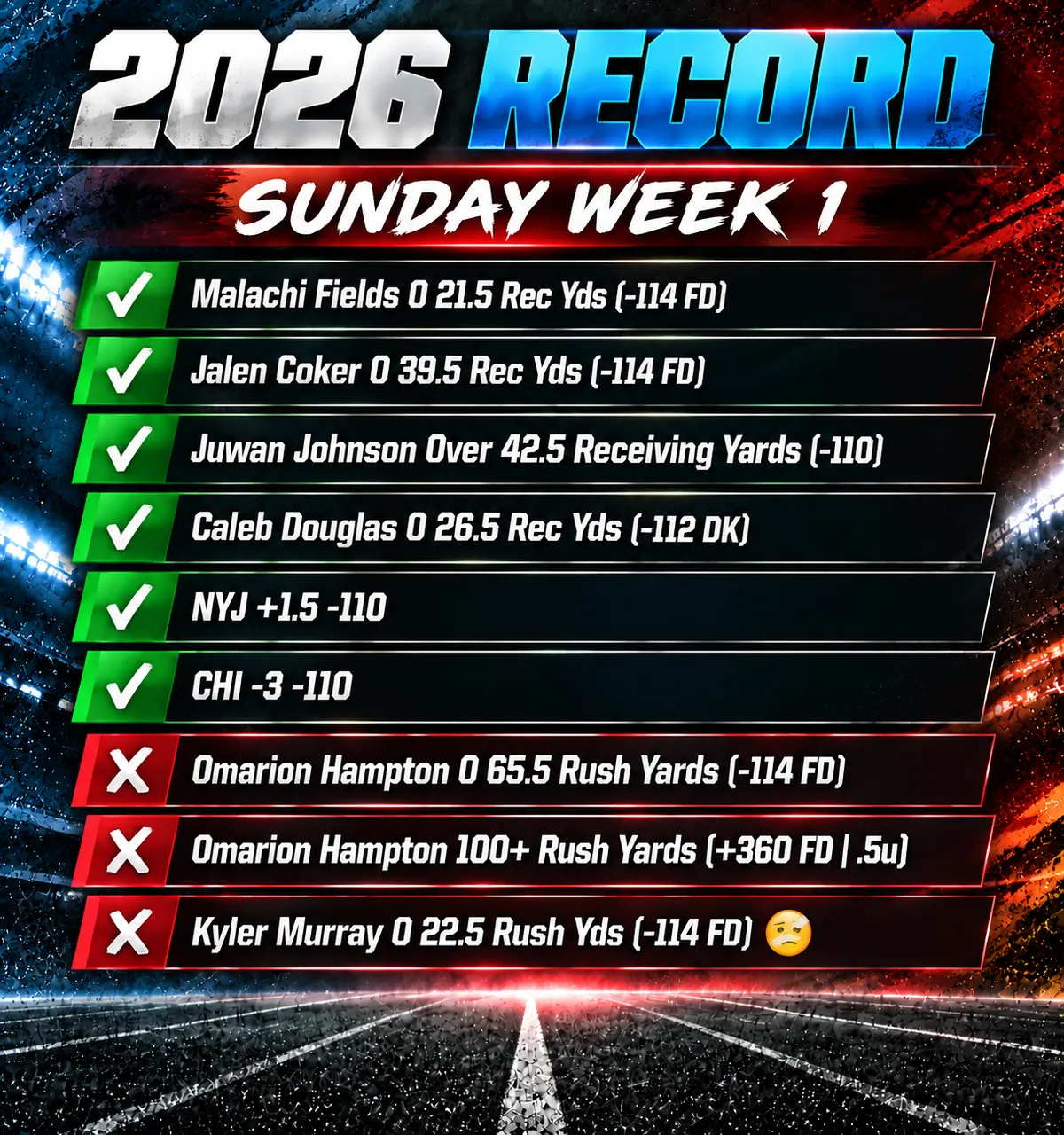
Sunday Week 1 finished 6-3, but the record itself isn't the most important part of reviewing the card. The goal each week is to go back through every bet, look at how the game actually played out, and determine whether the process behind the bet was good regardless of whether it cashed. There were several encouraging takeaways from Week 1, along with a few things we can tighten up moving forward.
Malachi Fields Over 21.5 Receiving Yards ✅
Fields barely got there with two catches for 25 yards, but the underlying usage was encouraging. The original reason for betting him was the opportunity opening up in the Giants' receiving corps. He'd performed well throughout camp, Darius Slayton was gone, and there was a legitimate chance Fields could establish himself as one of New York's primary receivers.
That's essentially what happened. Fields received four targets and played well ahead of some of the other receivers on the roster. Malik Nabers and Isaiah Likely are still going to command a large percentage of the passing game, so we shouldn't expect huge target volume every week. But Fields appears to have a legitimate role, which makes receiving lines in the 20s worth continuing to investigate.
Jalen Coker Over 39.5 Receiving Yards ✅
Coker was one of my favorite bets entering Sunday, and his performance only strengthened the reasoning behind it. He finished with eight catches for 138 yards and two touchdowns, blowing past the 39.5-yard line.
The important part wasn't the final yardage. The bet was based on what Coker had already shown late last season, when he cleared this number in seven of his final eight games and developed into a significant part of Carolina's passing game. His matchup against Chicago's coverage tendencies also looked favorable.
The 59-37 shootout obviously helped create additional passing volume, but Coker's role looks real. The sportsbooks will adjust after this performance, but Coker is absolutely someone we'll continue evaluating, especially when the opposing coverage structure fits his strengths.
Juwan Johnson Over 42.5 Receiving Yards ✅
Johnson cashed, although this is a good example of why we can't judge bets solely by the result.
The original reasoning made sense. Johnson averaged 57.4 receiving yards in games where Tyler Shough played meaningful snaps last season, had been playing some of the best football of his career late in the year, and entered a matchup where New Orleans was expected to throw frequently while playing from behind against Detroit.
The concern is how the usage actually materialized. Johnson wasn't heavily involved early, and Noah Fant received opportunities of his own. Johnson ultimately got the chunk play we needed, including a 27-yard reception in overtime. We need to downgrade Johnson to a guy we need to wait on and see how things play out.
Caleb Douglas Over 26.5 Receiving Yards ✅
Douglas was probably our best example of identifying an uncertain role before the sportsbooks had enough regular-season information to properly price it.
The rookie finished with five catches for 94 yards after entering Week 1 with a receiving line of only 26.5. Our reasoning was centered around Miami naming him a starter without an expected pitch count, combined with his size and vertical ability. That's also why we specifically targeted receiving yards rather than receptions. Douglas didn't necessarily need huge volume to beat such a low number.
After one game, the market is obviously going to adjust. But the larger lesson is important. Early in the season, sportsbooks are trying to determine these roles at the same time we are. When camp reports, depth charts and preseason usage point toward a much larger role than a player's prop implies, there can be significant value before the market catches up.
Jets +1.5 ✅
The Jets didn't just cover against Tennessee. They won 23-10 and controlled most of the game, outgaining Tennessee 367-195 while rushing for 152 yards and holding possession for nearly 39 minutes.
One of the most encouraging developments was New York's performance in the trenches. The offensive line didn't allow a sack, and the Jets were able to consistently control the game on the ground. That's something worth carrying forward because strong offensive-line play can influence everything from team sides and totals to rushing and quarterback props.
That doesn't mean we'll blindly bet the Jets going forward. It means New York's offensive line and ability to control games may have entered the season underrated by the market, and that Tennessee appears to be as bad as anyone in the league.
Bears -3 ✅
Chicago's offense was even better than expected in its 59-37 win over Carolina. The Bears generated 552 total yards, including 291 rushing yards, while Caleb Williams accounted for 334 total yards and four touchdowns.
The interesting part moving forward is separating Chicago's offense from its defense. Carolina still produced 478 yards and 37 points, so this wasn't a dominant performance on both sides of the football.
What Week 1 really did was increase my confidence in Chicago's offense. That makes Bears offensive player props and game Overs particularly interesting moving forward. The final score shouldn't convince us that Chicago suddenly has an elite defense.
Omarion Hampton Over 65.5 Rushing Yards ❌
Hampton is probably the most instructive loss from Week 1. He finished with 12 carries for 43 yards after we projected him for roughly 15 to 17 carries.
The matchup reasoning made sense. Arizona had struggled against the run, the Chargers were expected to play from ahead, and Hampton had averaged 4.4 yards per carry as a rookie. We also correctly identified his workload as the biggest concern before placing the bet.
Both the workload and game script came in below expectation. Hampton only received 12 carries, averaged 3.6 yards per attempt, and the Chargers never got the comfortable second-half lead we were hoping would generate additional rushing opportunities.
Kyler Murray Over 22.5 Rushing Yards ❌
Murray's loss goes into a completely different category. He suffered a head injury in the first quarter and was ruled out after recording nine rushing yards.
There's not much to change about the process here. The line was 22.5 yards for a quarterback who has consistently averaged more than 30 rushing yards per game, and we specifically identified his scrambling ability as the primary reason the number looked too low.
He had already accumulated nine yards before leaving in the first quarter. We can't assume he would have cleared 22.5, but the injury prevented us from getting enough football to meaningfully evaluate the bet.
What We're Taking Into Week 2
The biggest takeaway from Week 1 is how much opportunity there can be in receiving props when the market is still figuring out new roles. Fields, Coker and Douglas all entered the week with relatively low receiving totals, and each had evidence suggesting his actual role could be larger than the sportsbook was pricing.
That's an angle I want to continue attacking over the first several weeks of the season. Depth-chart changes, rookie usage, injuries and emerging target shares can create opportunities before the market has enough regular-season data to fully adjust.
Week 1 finished 6-3, but I'd classify 7 of the 9 bets as decisions I'd be comfortable making again based on the information available before kickoff. Hampton's base Over was defensible but exposed an important concern around the Chargers’ legitimacy this season.
That's ultimately the point of these weekly reviews. We're not trying to justify winners or make excuses for losers. We're trying to figure out what the games taught us, identify where our assumptions were right or wrong, and use that information to make better bets the following week.
Primetime Games
We went 2-4 across Wednesday and Thursday Night Football, but the record doesn't tell the full story. Two of the three losses were heavily impacted by injuries, while the other loss came on a bet where the game played out almost exactly how we expected.
Rashid Shaheed Over 31.5 Receiving Yards ❌
Shaheed finished with just one catch for four yards on three targets, but Sam Darnold left with an injury in the first quarter and didn't return. That completely changed Seattle's passing environment and made this bet difficult to evaluate.
The original thesis was that Shaheed's line was too low for his role. Jaxon Smith-Njigba was expected to draw Christian Gonzalez's attention, while New England's man-heavy defense created opportunities for Shaheed's speed and route quickness. We also expected around five to six targets to be enough for him to clear a number in the low 30s.
We never really got the chance to see that play out with Darnold healthy and I’ll likely stay away from Shaheed and most of the Seahawks offense with Drew Locke back there at QB.
Deebo Samuel Over 29.5 Receiving Yards / 40+ Receiving Yards ✅
This was the strongest process win of the primetime slate.
Deebo finished with six catches for 48 yards and a touchdown, plus a 12-yard rush. His longest reception was only 15 yards, which is important because it shows exactly how the original thesis played out.
We expected the Rams' improved boundary corners and pass rush to push San Francisco toward quick-game concepts, screens, underneath throws and manufactured touches for Deebo. That's exactly what happened. He averaged eight yards per reception and still cleared both receiving numbers.
This is something I'm carrying forward. Deebo doesn't need deep targets to produce in this offense. Shanahan can manufacture touches, and Deebo's ability after the catch gives him value against defenses that force San Francisco to get the ball out quickly.
Brock Purdy Under 37.5 Yards Longest Completion ❌
This was the most frustrating loss because most of the handicap was right.
Purdy played with an extremely low average depth of target, around 4.3 yards, the lowest of his career. San Francisco leaned heavily on short throws and quick concepts, exactly as we expected against the Rams' upgraded secondary and pass rush.
The problem was one play.
Purdy connected with Demarcus Robinson for a 39-yard touchdown, beating our Under by just 1.5 yards. It was his only completion longer than 15 yards.
I would still make this type of bet again. The lesson is that longest-completion Unders are fragile. One coverage bust, missed tackle or well-timed deep shot can ruin an otherwise correct read. Moving forward, I want a little more margin between the sportsbook number and our expected ceiling before betting this market.
Jake Tonges Over 9.5 Receiving Yards ❌
Tonges is another loss where the injury matters.
The original bet was based on George Kittle returning from an Achilles injury and San Francisco expected to manage his workload. That opened up additional tight end snaps and routes, with Tonges looking like the better receiving option behind Kittle.
Tonges then left with an injury in the first half before receiving a target. What happened afterward was encouraging for the thesis, though. His backup, Luke Farrell ended up taking on a significant role, which suggests those secondary tight end snaps and routes were available just like we expected.
That doesn't mean Tonges was guaranteed to cash. He hadn't earned a target before leaving. But the opportunity was there, and that's what we were betting on.
Once he's healthy, we'll need to reassess his role alongside Kittle's workload.
