The Curve
The Curve: Cognitive Bias in Betting
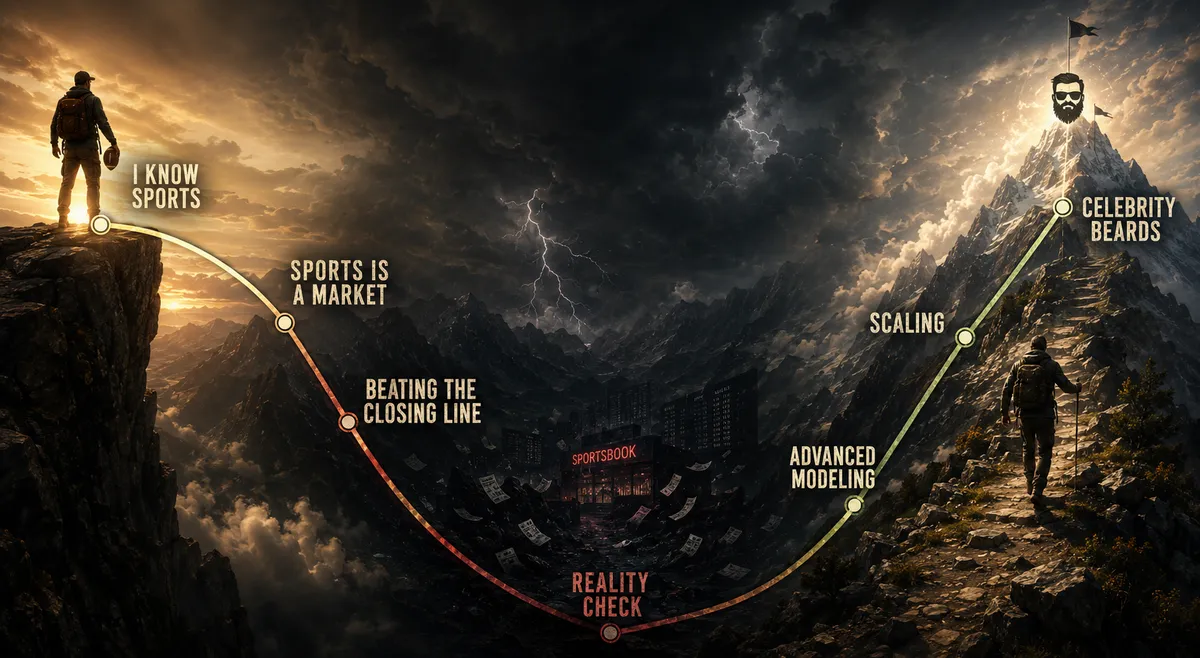
There is a curve that every bettor finds. The Dunning-Kruger Effect. It is not a theory anymore. It is a fact written in account equity. The curve looks like this: you start high, thinking you know something. You crash. If you survive the crash, you climb slowly back up. The ones who make it to the top are the ones who understand what happened in the valley and never go back.
The x-axis is the journey. I know sports. Sports is a market. Beating the closing line. Getting banned. Reality check. Advanced modeling. Scaling. Celebrity beards. Each step is a lesson. Most people quit before step five.
The y-axis is confidence. It rises fast at the start because you have not been punished yet. The market has not taught you humility. Then it collapses. This is where fortunes are lost.
Dunning-Kruger Effect
You know a sport. You know teams, players, coaches. You follow the league. Your confidence is highest when your competence is lowest. You have never asked yourself: What do I not know. Why would the market price a line this way. What am I missing. You do not ask questions. You assume you have the answers. You place your first bets. Some of them win. This confirms everything you already believed.
Then you hit the market for real. You place bigger bets. The variance catches up. Your account moves sideways, then backward. You are still confident because you have not been punished enough yet. You do not ask questions. You do not wonder why the line moved. You do not wonder what you got wrong. You are still certain you are right. You just need one more week.
But the market does not care about your timeline. You lose money. You hit a hard wall. You cannot explain why the line moved. You cannot predict what will happen next. You do not understand the market well enough to keep playing. This is the valley of despair. This is where the curve bottoms out. This is where most people quit.
The ones who make it past this point are the ones who realize something fundamental: they do not understand what they thought they understood. Not about sports. About the market. The market is not simple. The market is pricing in thousands of factors they never considered. What they thought was an edge was just a gap in their own thinking. What they thought was skill was just luck.
Once you understand this, the climb begins. You start asking different questions. What do I not know. Why are the lines moving the way they are. What is the market seeing that I am not. You stop assuming you are right and start assuming you are wrong until proven otherwise. You build systems that work even when you are wrong. You structure your bets so the right ones pay for the wrong ones. The climb is slow. It takes years. But the ones who make it to the top are the ones who learned to check their ego at the door and started asking questions instead of assuming answers.
The Biases That Trap You in the Valley
The real problem is not the biases. The real problem is ego. The real problem is not asking: What do I not know. Why did the line move that way. What is the market seeing that I am missing. But while you are in the valley, while your account is bleeding and you are refusing to admit you do not understand the market, these nine biases are what your ego looks like. These are the walls of the prison you built for yourself.
Confirmation Bias
You go looking for evidence that supports your thesis. You found it by accident on your first weekend, and now you are looking for it everywhere. You see a stat that confirms your read. You ignore the stat that contradicts it. The book made a mistake, you think. You know better. You place more bets. The losing bets you forget about. The winning bets prove you right.
Narrative Bias
The story makes sense, so it must be true. A team is clicking. A quarterback is playing with confidence. A defense found its identity. These narratives feel real because they sound like they mean something. ESPN is talking about it. NFL.com ran a piece. Sports talk radio cannot stop discussing how this team has turned a corner. The narrative is everywhere. So you believe it. You bet on it. You think you saw something everyone missed. But you did not miss anything. You just listened to the same narrative everyone else did. The media needs stories. The media needs momentum. A team that is just executing its system does not get talked about. A team with a narrative arc does. So the narrative gets amplified until it is so loud that casual bettors start buying it. By the time you are betting on it, the smart money has already faded the crowd.
Recency Bias
A team played dominant football last week. Unstoppable. Fast. Clean. In complete control. Now they are playing again. You watched the highlights and you see only what you just watched: perfection. You ignore their historical matchup splits. You ignore travel. You ignore what the opponent did two weeks ago. You see last week. That is all you see. You bet because of what you watched. The market already knew about the opponent. The market already factored everything else in. The market priced it all three days ago. You are just now seeing it.
Overconfidence Bias
You beat the closing line. Three weeks of it. Now you think you have the system. You think you understand the market better than everyone else does. You increase your bet size. You get more aggressive. You feel like you are playing with house money. Then the market adjusts. Your edges shrink. Your sample size was smaller than you realized. You are about to get flattened.
Attribution Bias
When you win, it is because you are good. When you lose, it is because of bad luck or a bad beat. You credit your skill for the wins and the gods for the losses. This lets you keep your confidence intact while your account gets smaller. A team you bet on lost because they had a down day. You picked them right but the universe was against them. But the team you bet on that won? That was you. You saw it coming. You know the market. Your confidence grows while your edge erodes. You cannot learn from mistakes you will not admit you made.
Hindsight Bias
You look back at a game and say: I knew that would happen. That team was going to lose. I saw it coming from a mile away. But you did not bet it. You bet something else. Your memory rewrites the past to fit the present. You convince yourself you knew something you did not actually know. This keeps you confident even as your account bleeds. You cannot learn from a past you are rewriting.
Loss Aversion
A loss hurts twice as much as a win feels good. This is not opinion. This is neuroscience. So when you are down, you get desperate. You make bigger bets to get even. You take worse odds. You accept lower expected value because the pain of the loss is too much. You are trying to feel okay again. The math does not matter anymore. The only thing that matters is erasing the deficit. You will bet a parlay you would normally never touch because it pays enough to get you whole. You will chase. And chasing is where accounts die.
Sunk Cost Fallacy
You have lost five thousand dollars. Five thousand is too much to give up. So you keep betting to get it back. You tell yourself you just need one good week. One perfect week and you are whole. But that is not how the math works. Your odds do not improve because you are down. Your edge does not get bigger because you are desperate. You are just betting more with a worse mindset. The five thousand is gone. The question is whether you lose six.
Gambler's Fallacy
A coin has come up heads five times. Tails is due. The market has been overpricing home dogs for six weeks. Home dogs must be due to underperform. This is not how probability works. Each game is independent. Each line is independent. But you do not feel that way. You feel like the market owes you. You feel like variance is conspiring against you and it has to reverse. So you bet the opposite of what the math says because you believe in reversion. The market is not due. The market is efficient. You are about to lose money to randomness you tried to predict.
The Climb Out
The valley is not permanent. The curve does not stop at the bottom. The ones who get out are the ones who stop defending and start questioning. Every question you ask is useful. Why did that line move. What was I wrong about. What does the market know that I do not. Every bit of study sharpens the edge. Every loss that teaches you something is worth more than a win that teaches you nothing. The climb is slow because understanding is slow. But it is the only way out. Stop assuming. Start asking. The market will teach you if you are willing to listen.
Fortune, it is you I follow.
Swish
