
They Will Lose: Gen Z and the Sportsbooks
Quite a few recent articles have come out describing Gen Z's betting habits. The coverage frames it as a betting trend. Young people gambling instead of investing. Poor financial decisions masquerading as strategy.
At first glance that is all it looks like. Addiction. Recklessness. A generation throwing away money on app-based thrills instead of building real wealth.
Zoom out. The real story is not about gambling. It is about Rome.
What the Research Shows
Fifty-two percent of Gen Z investors have redirected money meant for stocks and retirement into sports betting over the past year. Twenty-six percent now treat sports betting as a deliberate part of their long-term financial plan. Only one-third of Gen Z investors do not participate at all.
The Betterment survey tracked a thousand U.S. retail investors across four generations. The results are stark. Gen Z is not casually betting. Gen Z is treating sportsbooks as financial institutions.
Bank of America tracked payment flows to and from betting platforms. Customers of all generations recovered less than 75 cents for every dollar sent to sportsbooks each month. Gen Z performed marginally better, recovering over 80 cents per dollar, but still fell catastrophically short of breaking even.
Americans legally wagered 167 billion dollars on sports in 2025. Up from 13 billion in 2019. That is an 1100 percent increase in six years. That is not a market expanding. That is capital flowing from the young into the books because the young have given up on traditional wealth building.
Credit card delinquencies among sports bettors under 40 jumped 26 percent post-legalization. Median bank balances for betting households are 59 percent of non-betting households. They are not using recreational money. They are using money they cannot afford to lose.
Eighty percent of Gen Z engaging in high-risk activities like sports betting say they do so because they feel financially behind and see these activities as a better path to their financial goals than traditional methods.
Why They Don't Have a Chance
Markets are efficient. The sportsbooks are not magical entities. They are not stealing from you through some secret science. They are operating in markets that price faster and tighter than ever before.
The juice is the friction. Twenty cents of every dollar wagered goes to the sportsbooks. Not sometimes. Every time. Every month. Every year. This is not edge. This is extraction.
You can beat the books. Real people do. Sharp bettors with professional infrastructure, capital, data, and discipline can close that gap. It takes years. It takes learning data science. It takes understanding why the market prices the way it does. It takes separating yourself from the 99.9 percent of people who lose.
A Gen Z kid with an app and a sports opinion does not have the infrastructure to compete. The market is too efficient. The juice is too high. The work required is too much.
The Sportsbooks Know Exactly What They Are Doing
The apps are engineered for speed. Tap three times and your money is deployed. The friction is gone. The casino used to require you to leave your house, walk to a desk, and verbally commit to a bet. That friction was protection. It slowed you down. It gave your brain time to say no.
Now the sportsbooks have eliminated every single barrier. One-click betting. Parlays that look easy but are designed to lose. Live betting that triggers the exact behavioral patterns that maximize wagering velocity. Player props that feel like edge plays but are actually just more ways to extract the vig.
The sportsbooks are not operating casually. They have behavioral psychologists. They have data scientists. They have predictive models that tell them exactly how much to let you win early so you will chase losses later. They are weaponizing the fact that Gen Z feels financially behind and desperate.
As the New York Times investigation revealed, a certain sportsbook built machine learning models to identify losing gamblers and target them with more promotions. The best investment, they concluded, is a problem gambler. More on this later. But know that every feature of the app is built to separate you from your money as efficiently as possible.
The Real Crisis: Purchasing Power Since 2000
Why is this happening?
In inflationary times, the dollar is a bad measuring stick for true wealth. Dollars can be printed infinitely. Gold cannot. Real assets cannot. If you want to know if you are actually getting richer or poorer, measure your income in gold, not dollars.
Since 2000, median income in the United States priced in gold has actually gone down. Pricing things in gold is one of the ways to measure true inflation. This says that since 2000 the median person has gotten poorer on a real basis despite making more dollars.
Why does this matter? Because something fundamental changed in 2000. Before that year, wages and assets moved together. Hard work and saving built wealth. The system worked.
After 2000, the Fed began printing. Asset prices exploded. Housing doubled, then tripled. Stock markets soared. But wages stayed flat. If you earned in dollars and tried to save, your savings collapsed in real terms. If you owned assets before 2000, you got rich. If you entered the workforce after 2000, you got poor.
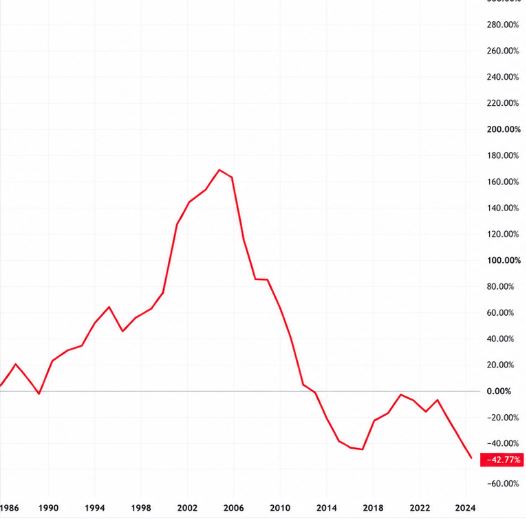
Gen Z entered the workforce in the post-2000 world. They have never known a system where hard work and saving builds wealth. They have only known a system where your purchasing power collapses every year no matter what you do. Work full-time and save aggressively and you are still losing ground. The math is absolute.
What This Does to Society
Researchers have studied what happens when a society experiences this kind of wealth divergence. The findings are consistent and dark.
When purchasing power collapses for one generation while assets explode for another, belief in the system evaporates. Young people stop investing in the future because they have stopped believing there is a future for them. They stop saving. They stop planning. They stop believing in institutional solutions.
They turn to what researchers call exit strategies. Risky bets. Speculative plays. Anything that offers the fiction of jumping the line. Because the line does not work. The line is a trap.
The traditional path is mathematically impossible. A Gen Z person working full-time cannot save enough to buy a house. They cannot save enough to retire. They cannot build generational wealth. The system is not designed for them.
And so they turn to sports betting. Not because they are stupid. Not because they are addicted to gambling. But because the sportsbook is offering the only thing left: the illusion of control and the fiction that they might beat the odds and skip the line.
Eighty percent of Gen Z betting say they feel financially behind and see betting as a better path than traditional methods. They are not wrong about the system being broken. They are just wrong about sports betting being the answer.
Know the Blade
If you are going to bet, understand this: you are fighting against 20 cents on every dollar. You are fighting against algorithms designed to extract you. You are fighting against markets that price faster and tighter than ever.
You can win. People do. But it takes more work than most people are willing to give. It requires learning. It requires discipline. It requires separating yourself from the 99.9 percent who lose.
The alternative is simpler: do it for entertainment. Treat it like a movie. You pay money to watch something unfold. You get the thrill. You accept the loss as the cost of the experience. Do not mistake it for wealth building. Do not redirect investment capital to it. Do not treat it as a financial plan.
But do not fool yourself. Markets are efficient. The juice is real. The sportsbooks are not your enemy. They are just operating in markets where the vig is the edge and your capital is the product.
You know the blade going against you. Understand what you are betting on.
This is not financial or investing advice. Consult a financial advisor before making any investment decisions.
Fortune, it is you I follow.
Swish
